

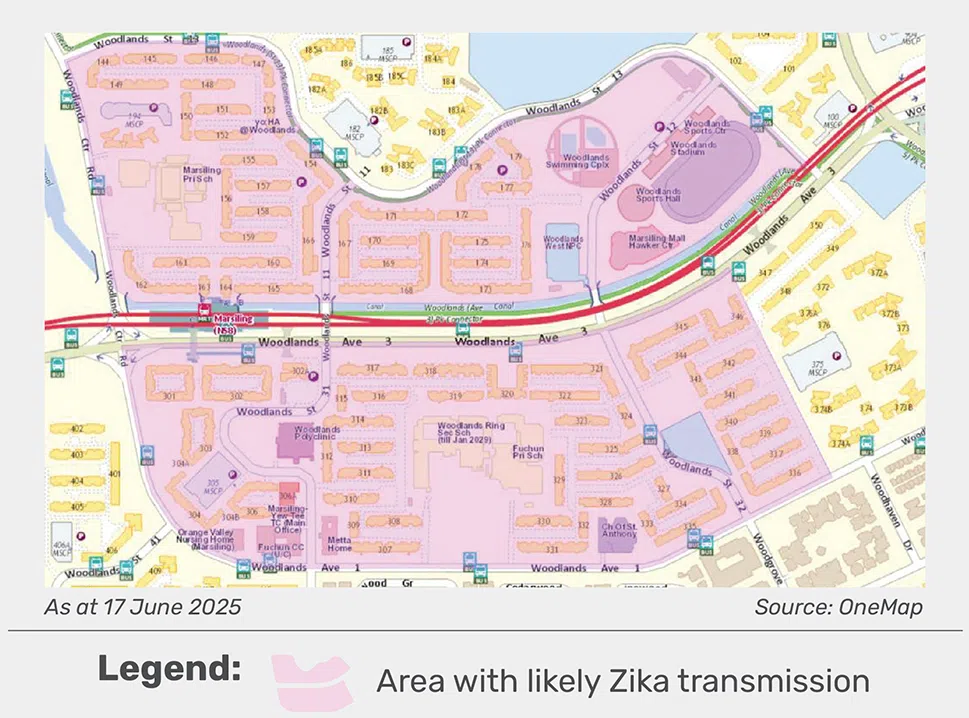
On June 19, the National Environment Agency (NEA) and the Communicable Diseases Agency (CDA) announced that two local Zika cases have been confirmed at Woodlands Street 11 and Street 32.
Following the notification of each case, NEA initiated wastewater and mosquito surveillance activities in the surrounding residential areas.
Enhanced surveillance efforts have detected persistent Zika virus signals in the area, indicating a high likelihood of Zika transmission in that area.
NEA regularly conducts surveillance to prevent the spread of vector-borne diseases in Singapore. This includes using gravitraps placed around Housing Board estates to capture the urban-dwelling and day-biting Aedes aegypti mosquitoes, which are known to transmit Zika and dengue.
As of June 12, a total of seven Zika cases have been reported in Singapore for the year 2026, with the most recent case confirmed on June 11. In 2024, there were 13 reported Zika cases locally.
NEA advises individuals showing symptoms suggestive of Zika infections to seek medical attention promptly. Symptoms may include rash, fever, conjunctivitis, muscle pain, joint pain, and headache.
While there is no specific treatment for Zika infections, pregnant women who are infected are urged to consult their obstetricians for appropriate management, as Zika can lead to congenital defects in infants, including neurological complications and microcephaly.
For more information on Zika cases, individuals can visit go.gov.sg/zikaclusters or the CDA's webpage at go.gov.sg/zika to learn about symptoms, prevention, and treatment options.
The Straits Times has reached out to NEA and the Ministry of Health for further details.
Advertisement


Advertisement


Advertisement


Advertisement